
Grow the Tax Base, Don’t Raise the Bill
$900 is groceries and gas. It's not a plan
At a Glance
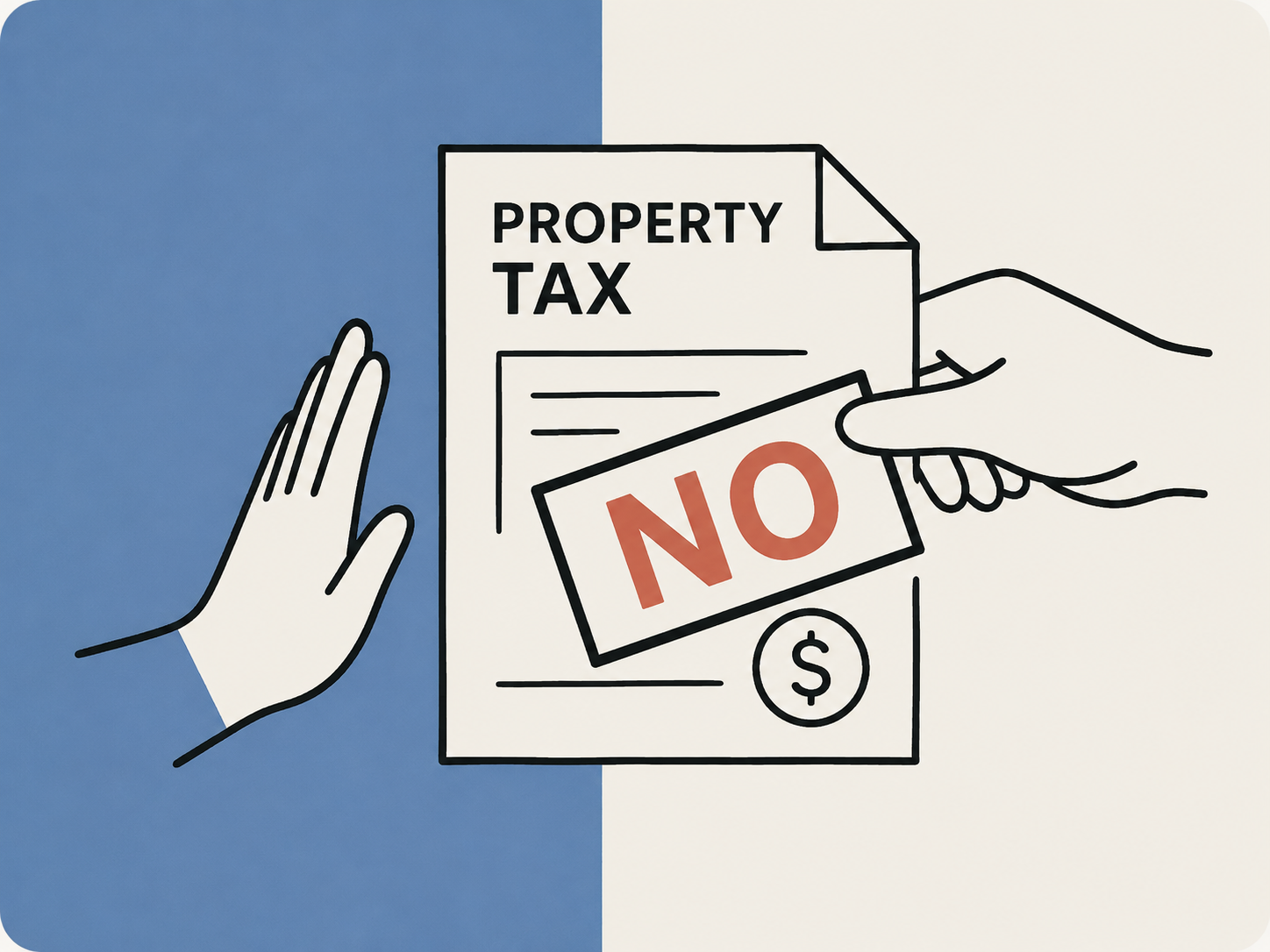
The vote: On June 1, the County Council decides whether to raise property taxes by the highest rate since 2001, adding roughly $900 a year to the average homeowner's bill.
My position: I oppose this rate increase. If elected, I will vote no on measures like it until the county has a real plan to grow the tax base.
My plan: Work to attract high-target companies that bring high-paying jobs to our county and invest in our strong economic base: life sciences, biotech, hospitality. Require a line-item spending review before any rate increase. Make existing safety net programs actually work for the people who need them.
On June 1, the County Council votes on whether to raise the property tax rate by 6.3 cents per $100 of assessed value, the highest rate Montgomery County has seen since 2001.[1] For the average homeowner, combined with rising assessments, that is roughly $900 a year.[2] That is groceries. It is gas. It is the utility bill that has already gone up. It is not an abstraction: it is money that is already spoken for. Here is why I oppose it, and what I would do instead.
The county faces an $854 million revenue shortfall over the next six years.[3] A one-time rate increase does not fix that. It delays the real conversation, which is about how we grow and diversify the tax base rather than repeatedly drawing from the same residential well. In Takoma Park last week, an elderly gentleman told me their tax bill is already likely forcing them to sell the home where they have lived for decades. They are not asking for a tax waiver. They are asking for a government that plans ahead rather than reaches into the same pocket every year.
The alternative is not to ignore the shortfall. It is to address it honestly. That means three things: growing the tax base, demanding accountability for how we spend what we already collect, and making sure existing safety net services reach the people who need it.
First, grow the tax base.
Montgomery County is home to 77,550 federal employees, including the headquarters of the National Institutes of Health (NIH) and the Food and Drug Administration (FDA).[4] Thousands of those workers now face displacement.[5] Our county is also home to one of the most promising life sciences corridors on the East Coast, including Samsung Biologics, AstraZeneca, Medimune and a growing cluster of biotech firms in Rockville and Gaithersburg that represent real jobs, real tax revenue, and real opportunity for our residents and students.[6] That corridor needs exactly the kind of skilled workforce that federal health agencies have built here over decades. The county should be actively building that bridge: workforce transition programs, employer partnerships, and a recruitment strategy that turns today's disruption into tomorrow's tax base.
Second, conduct a line-item review.
The proposed budget grows at 5.7%, more than double the rate of inflation.[7] Montgomery County Public Schools (MCPS) accounts for 51% of the operating budget and is requesting $189.9 million more than last year.[8] That funding may be justified. But it requires specific answers. At Sligo Creek Fest, I met a father who spent months preparing documentation for his son's school accommodations, only to be told by staff he was wasting their time. Accountability for how MCPS spends public money is not anti-schools. It is pro-family.
Third, make our safety net work.
Asking residents for more while leaving existing assistance unclaimed is not a responsible government. Programs for the homeowners most at risk already exist, but they are not reaching people. The county's low-income Homeowners' Property Tax Credit (HOTC) reached just 4,486 residents last year.[9] As recently as 2023, more than 80,000 properties were at risk of losing a $692 tax credit simply because no one filed a form.[10] If you cannot manage the programs you have, you have not earned the right to ask for more.
The residents I am meeting across District 4 are not against schools or services. They are asking for a government that spends carefully, plans ahead, and protects the people with the least room to absorb another bill. If elected, that is the standard I will hold.
Sources
[1] Montgomery County Council staff report, March 2026; Montgomery Perspective, March 13, 2026.
[2] Montgomery Perspective, March 23, 2026. Calculated using average assessed value of a Montgomery County single-family home ($702,755, per SDAT, July 2025) and the proposed rate of $1.0885 per $100. Includes estimated impact of rising assessments phased in over three years. County-wide average; District 4 homeowners may see a lower figure.
[3] WJLA, reporting on the Montgomery County six-year fiscal forecast, 2026.
[4] Montgomery County Economic Development Corporation (thinkmoco.com); Maryland Comptroller report, January 2026.
[5] Maryland Comptroller and University of Maryland report, January 2026. Under targeted cuts (FDA 18%, NIH 6%), an estimated 4,200 Maryland resident jobs are at risk. Under a full 24% HHS cut, approximately 8,400.
[6] Maryland.gov economic development report, Q2 2026.
[7] Montgomery Perspective, March 13, 2026. Inflation benchmark: Washington-Arlington-Alexandria CPI-U, year ended November 2025.
[8] Montgomery County Executive recommended budget, March 13, 2026.
[9] Montgomery County Department of Finance, FY26 budget data.
[10] Montgomery County government bulletin, April 2023. Note: this figure relates to the Income Tax Offset Credit (ITOC) Homestead application requirement — a separate but related program — and reflects the same pattern of enrollment failure across county relief programs.
All claims are drawn from publicly available government documents, the Montgomery County budget record, and local journalism. Calculations are noted where figures are derived rather than directly reported.